


Georgia Institute of Technology
Role
Product designer
AI engineer
Results
Integrated into the MS-HCI Slack workspace for use by future students
Submitted to Conversational User Interfaces (CUI) conference
Introduction
Course registration is a persistent challenge in higher education. Students must navigate degree requirements, scheduling constraints, and information scattered across multiple systems when planning their academic paths, creating confusion and frustration for both students and academic advisors.
That led to our central question:
We started by understanding how students actually plan their courses
We interviewed six MS-HCI students and five administrative stakeholders to understand how students navigated course planning and where the process broke down.
Students described navigating vague course descriptions and scattered resources, while administrators saw students struggling to keep track of communications and degree requirements.

The issue wasn’t necessarily a lack of information. The real problem was that students had to find, reconcile, and interpret information scattered across multiple sources themselves.

Students wanted more than registration answers
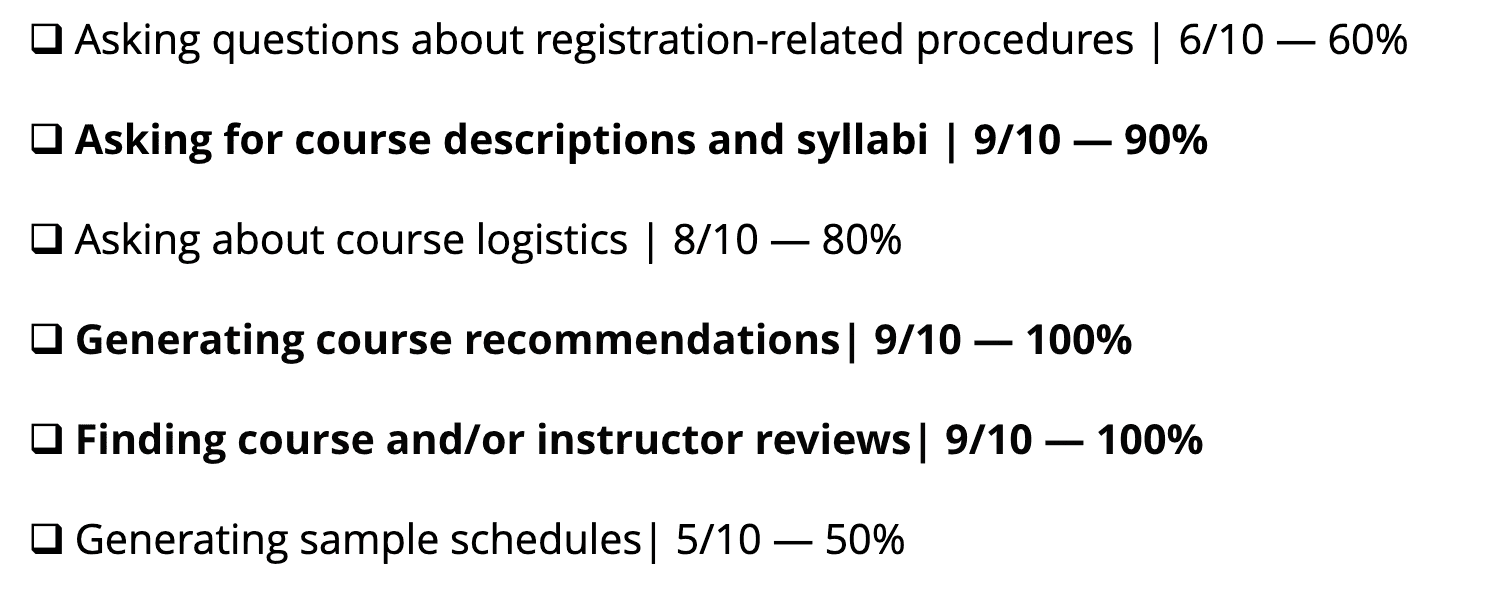
In a survey of MS-HCI students, 9 of 10 wanted course descriptions and syllabi, while 8 of 10 wanted course logistics. Students also described wanting recommendations that considered their schedules, degree requirements, course reviews, and the actual content of each class.
These findings shifted our focus from simply answering registration questions to helping students evaluate and compare their options.
Bringing course planning into one place
We designed Next Course, an AI academic planning assistant that brings fragmented course information into a single conversational experience. Rather than searching across multiple resources, students could ask questions naturally to explore courses, understand degree requirements, and receive recommendations based on their individual goals.


To ensure responses remained grounded in reliable information, Next Course pulled from three primary sources: Georgia Tech’s course catalog, the MS-HCI handbook, and Georgia Tech's website. We implemented a fourth, last resort option to search the web if these sources were insufficient.
The agent could determine which sources were relevant to a student’s question, retrieve the information, and combine it into a single response.
This allowed Next Course to answer straightforward questions while also handling more nuanced requests, such as comparing courses or recommending classes based on a student’s interests and goals.
We put the assistant where students were already looking for answers
Our research showed that students already relied heavily on Slack to ask questions, share course experiences, and find registration information. Instead of introducing another platform, we brought Next Course into an environment students were already using.
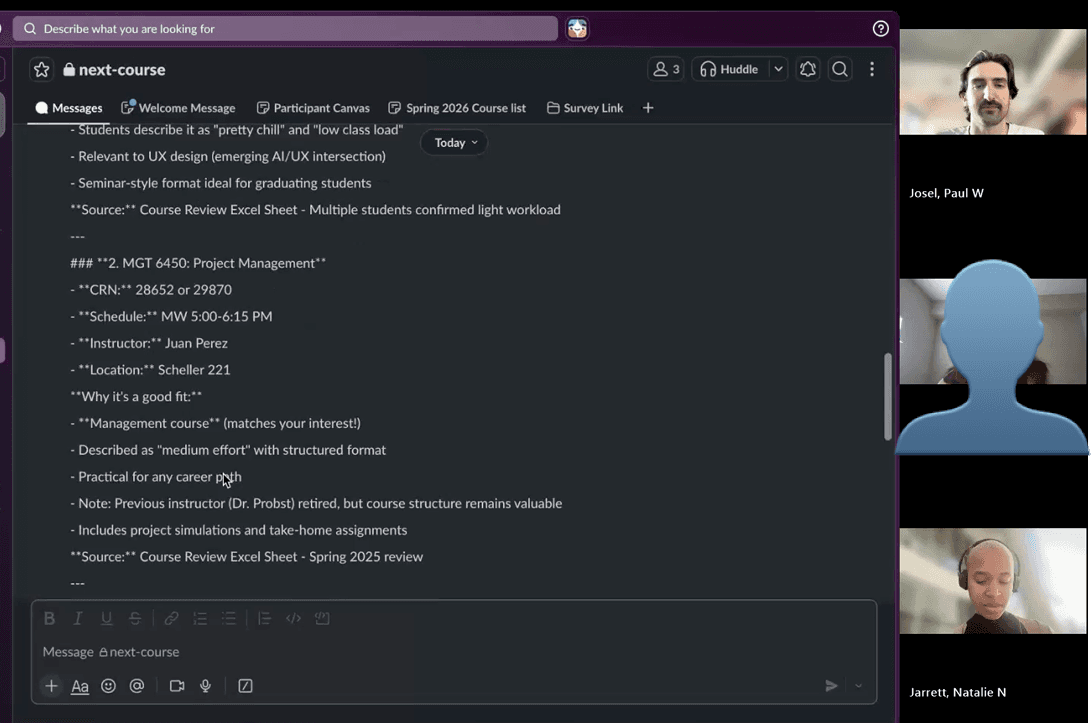
We built a custom Slack application that connected the conversational interface to the Next Course agent, allowing students to access its capabilities without changing their existing workflow. The prototype was initially deployed in a test MS-HCI workspace.
Putting Next Course in students’ hands
We tested Next Course with seven MS-HCI students, asking them to complete two common planning tasks: investigate a course they were considering and find course recommendations based on their individual goals.
Students responded especially well when answers reflected their personal priorities and incorporated resources they already trusted. They also valued having information consolidated within Slack rather than searching across multiple sources.
Students found Next Course more useful than their existing process
Testing validated the core concept. Students rated Next Course highly for both usefulness and relevance, and agreed that it improved upon their typical approach to finding and choosing courses.


The feedback also revealed opportunities to improve clarity, organization, and transparency, particularly around how the assistant selected and presented information from its sources.
Exploring a more scalable approach
Following our initial testing, we built a second version of Next Course using Retrieval-Augmented Generation (RAG) to explore an architecture better suited for a full-scale deployment. We then compared it against our original tool-based assistant using answer correctness and relevance.

The tool-based system performed better in our evaluation, particularly when interpreting complex, structured documents. The RAG approach, however, offered faster responses, greater document capacity, and a simpler path to deployment.
Conclusion
Next Course began with a simple challenge: students had the information they needed, but finding and connecting it required navigating a fragmented collection of resources.
By bringing those resources into a single conversational experience, we demonstrated how AI could help students explore their options, receive personalized guidance, and make more informed course decisions without replacing the resources or advisors they already trust.
The next step is expanding Next Course to broader deployment within Georgia Tech.
© 2026